The Samsung Electronics labor union has announced a general strike and reported plans for a protest outside the residence of Chairman Lee Jae-yong. The union is demanding a performance bonus equivalent to 15% of operating profit and the abolition of the performance bonus cap. This action is interpreted as the largest labor-management dispute in Samsung Electronics' history.
The Samsung Electronics labor union has declared a general strike following difficulties in wage negotiations with management and announced a protest in front of Chairman Lee Jae-yong's residence, escalating labor-management relations to an unprecedented level of tension. The union stated that it would commence a general strike from the 21st of next month, with plans to hold a protest on the first day in front of Chairman Lee Jae-yong's Hannam-dong residence. Such a move is highly likely to be recorded as the largest labor-management dispute since Samsung Electronics' founding. On the morning of the 24th, the union reported to the Yongsan Police Station in Seoul its plan to hold a rally around 1 PM on the 21st of next month in front of Chairman Lee Jae-yong's residence in Hannam-dong. While the reported number of attendees is approximately 50, a union official explained that it is more likely to be a press conference announcing the general strike plan rather than a demonstration, and the specific number of participants has not yet been determined.
▲ General Strike Declaration and Plans for Protest Outside Chairman Lee Jae-yong's Residence
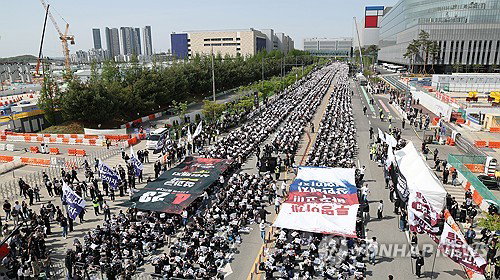
The multi-company union of Samsung Electronics already declared a hardline stance by holding the 'Change Transparently, Abolish the Cap - 4/23 Struggle Resolution Rally' on April 23rd at Samsung Electronics' Pyeongtaek Campus in Pyeongtaek, Gyeonggi Province. Approximately 40,000 union members participated in this rally, showcasing the union's solidarity. At the event, the union urged for 15% of operating profit to be paid as performance bonuses and for the institutionalization of the abolition of the performance bonus cap. These demands are analyzed as a result of accumulated dissatisfaction among employees regarding the performance distribution system, despite Samsung Electronics' recent improvement in performance. In particular, as the recovery in the semiconductor sector's performance became evident, employees' expectations rose, and the failure to narrow the gap with management's position appears to have deepened the conflict. Samsung Electronics previously adhered to a 'no-union management' principle, but since Chairman Lee Jae-yong declared the abolition of no-union management in 2020, union activities have become more active, ushering in a new phase of labor-management relations. This general strike declaration is considered a symbolic event demonstrating the expanding influence of the union within this changed environment.
▲ Union's Key Demands and Background of the Struggle
This general strike announcement is expected to cause significant repercussions across the industry, given its potential to directly impact Samsung Electronics' production and business activities. As a company playing a pivotal role in the global IT and semiconductor markets, a union strike could have profound effects beyond mere production disruptions, extending to global supply chains. In particular, the shutdown of major semiconductor production lines carries the risk of triggering a domino effect on worldwide electronics manufacturing, which could also negatively affect domestic and international partners. Furthermore, the protest outside Chairman Lee Jae-yong's residence has the potential to expand beyond a simple wage negotiation issue to encompass corporate governance and management transparency concerns. This is considered a significant matter that could set a precedent not only for Samsung Electronics but also for labor-management relations in other major domestic conglomerates. The union has stated that the general strike will continue from the 21st of next month until June 7th, and if prolonged, its impact is expected to intensify further. The market is also raising concerns about increased volatility in Samsung Electronics' stock price and a potential weakening of investor sentiment.
▲ Future of Samsung Electronics' Labor-Management Relations and Industry Repercussions
The trajectory of the Samsung Electronics labor-management dispute holds significant implications for the overall South Korean economy. Amid ongoing global economic uncertainties, production disruptions in a key domestic industry could directly burden the national economy. Management faces a strategic dilemma: whether to accept the union's demands or propose alternative negotiation terms. The union, too, is required to adopt a cautious approach, considering the practical impact of the strike and the direction of public opinion. This situation could mark a new turning point in labor-management relations for large corporations and is highly likely to spark broader societal discussions on performance distribution and corporate governance. Industry experts warn that if both sides fail to reach an amicable agreement, it could negatively affect Samsung Electronics' brand image and global competitiveness. Particularly, at a time when competition in artificial intelligence (AI) semiconductors is intensifying, a prolonged labor dispute raises concerns about potential disruptions to core technology development and production roadmaps. The future dialogue and negotiation process between management and the union are expected to become a crucial benchmark for the South Korean industry.
![[금융진단] 미 증시, 지정학 완화·빅테크 반등에 상승](https://images.jkn.co.kr/data/images/full/98/28/982892.jpg?aspect_ratio=288:168&crop_gravity=northwest&width=288)